Google Marketing Live 2026 happened yesterday. It’s the annual event where Google reveals what’s changing across Search, Ads, and YouTube for the next 12 months. Agencies and ad-platform people circle it on their calendar months in advance. If you run a home service business, whether that’s HVAC, plumbing, roofing, electrical, landscaping, or pest control, you probably didn’t watch it. You probably hadn’t even heard of it. You had a callback to run, a tech to chase down, a slow shoulder season to plan around. We watched all two hours so you didn’t have to.
The short version: most of what Google announced wasn’t built for you. The longer version is more interesting. The platform that brings you most of your booked jobs just got rewired around AI, and the operators who pay attention this year are going to take ground.
This wasn’t a small announcement day. Google rewired Search, YouTube, and its measurement stack around AI in ways that will reshape how every homeowner finds a service business over the next 18 months. If you ignore it, the franchise three zip codes over won’t. They’ll adopt this stack, their cost per booked job will drop, and you’ll quietly lose ground in a service area you should be winning.
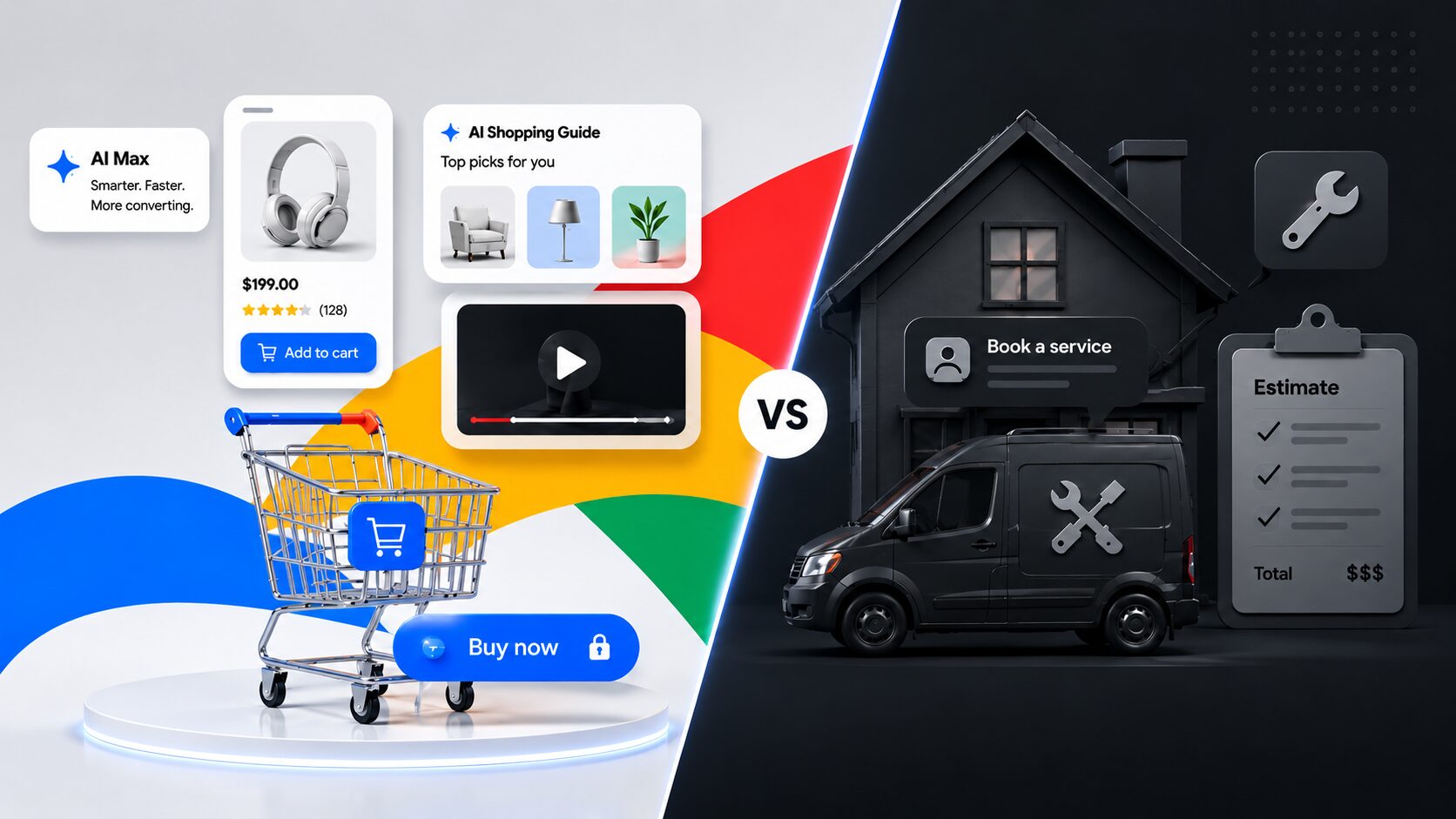
Here’s what was actually on stage: a frictionless ecommerce future. Universal Cart. Native checkout in YouTube ads. Direct Offers with one-click payment. Shopping ads with AI-generated explanations. All built around the assumption that the buyer can complete the transaction on the same screen they discovered the product on. That story makes sense if you sell a $40 duvet. It makes less sense if you sell a $14,000 mini-split install, a roof replacement, or a finished basement that needs an in-home estimate.
But the bones underneath those announcements are a real shift: how Search works, how leads get measured, how creative gets made. Most of it is good news for local home service operators who pay attention. Google didn’t build a single new ad format aimed at our category. The underlying changes still hand the operators who adapt a real edge. Here’s what to actually do.
Search rewards specificity now — write like an operator, not for bots
AI Overviews has 2.5 billion monthly users. AI Mode crossed a billion and is doubling every quarter. The queries are roughly three times longer than the keyword searches you optimized for five years ago. Homeowners are now beginning to ask things like “best plumber in my area that handles old cast iron stacks and gives a written estimate,” over “plumber near me.”
That length is a gift to a real operator. A generic franchise page can’t answer a specific local question. A page written by someone who has actually pulled cast iron out of a 1920s house can. Google’s own guidance from the stage was blunt: lead with what only you can say, share firsthand experiences, share real reviews, share expert takes. Don’t write for bots. Write for the homeowner. The pages getting cited in AI Mode are the ones with specificity, photos, video, and the kind of detail an operator notices that a copywriter doesn’t.
The boring follow-up: get your Google Business Profile actually filled out. Service area accurate. Hours right. Reviews responded to. Categories specific. AI Search pulls heavily from structured business data. The operators who treat their GBP like a serious profile will outrank the ones who set it up once in 2019 and never touched it again.
Keyword strategy is evolving — AI Max and PMax are the new floor
Google’s framing on stage was blunt: the days of manually picking keywords to match every query are ending. Conversational AI Mode queries are too long, too varied, and too contextual to map cleanly to a manual keyword list. Keywords still matter as themes and signals. What’s changing is which layer of the stack does the matching, and it isn’t your account manager picking exact-match terms anymore.
AI Max for Search is out of beta, driving 27% more conversions than manual campaigns. Advertisers using AI Max or Performance Max are seeing 15% more conversions at the same return on spend. Every new ad format announced in AI Mode is exclusive to AI Max and PMax.
That last point matters. There was exactly one new ad format aimed at our world: Business Agent for Leads. It’s an agentic ad inside AI Mode that lets a prospect ask a question, get an answer based on your website, and submit a pre-filled lead form. It’s currently in pilot for Education, Automotive, and Real Estate. Home services wasn’t on the launch list.
Translation: it’s coming, but the operators already running AI Max and PMax alongside their keyword campaigns will be first in line when it arrives. The ones still leaning entirely on manual keyword-only setups will be retrofitting against the deadline.
Demand Gen on Google Maps is the launch nobody talked about
The single most under-covered announcement in the entire keynote: Demand Gen ads are expanding to Google Maps. For a service business, Maps is where homeowners go when they’ve moved past “researching” and into “calling someone.” Until now, Maps was essentially a Google Business Profile–only surface. Adding Demand Gen means you can place a visual, intent-matched ad in front of someone who is one tap away from dialing.
If you run a roofing company in a storm-prone market, or a landscaping outfit at the start of spring, or an electrician in a region with permit-driven demand, this is the closest thing to a free move Google handed local operators this year. Test it early. The cost will go up as adoption catches on.
The metrics finally fit a multi-month sales cycle
Two new measurement signals, both quietly enormous for our category:
Attributed Branded Searches (ABS). When someone sees your ad and then searches your brand name a week later, you now get credit for that. Always on, no experiments needed. For service businesses that win on reputation, this is the first time Google has measured “brand recall” as a real conversion signal.
Qualified Future Conversions (QFC). A predictive metric that estimates the long-term value of an ad exposure up to six months out. Google highlighted a retailer that ran a campaign looking flat at 30 days. The QFC view revealed a 70% uplift in long-term conversions. They scaled it instead of killing it.
For HVAC operators selling a system replacement, a roofer working a six-month consideration cycle, or a landscaper closing big design-build jobs in winter for spring install, 30-day attribution has been quietly killing prospecting budget for years. QFC fixes that, but only if you’re feeding Google the right signals to predict from. Which brings us to the most important shift of all.
Stop optimizing for form fills — feed booked-job data back into Google Ads
The single most consequential line of the entire event came from Christine Turner, Google’s measurement lead: stop optimizing on early signals like form fills. Feed the actual outcome back into Google Ads, so the AI optimizes for what actually pays you. The booked job. The closed revenue. The lifetime value.
This is the unsexy plumbing that decides whether AI works for you or against you. Most home service businesses point Google Ads at “lead submitted” as the conversion. The AI dutifully finds you more form fills. Many of them tire-kickers, wrong service area, wrong price range, not actually ready to buy.
When you push booked-job data back from your field service software or CRM (ServiceTitan, Jobber, Housecall Pro, HubSpot, whatever sits between your dispatch and your books), the AI starts optimizing for the leads that close. Your cost per booked job drops. The franchise next door, still optimizing on raw lead volume, is paying for noise.
Google made the connector layer easier this year. Data Manager and Google Tag Gateway both got upgrades aimed exactly at this. But the implementation is on you and your agency. It is the single highest-leverage move a $1–5M home service business can make this quarter.
Creative is now a problem you can actually solve
Asset Studio integrated Gemini, Veo, and a tool called Pomelli that takes your website URL and generates on-brand images and short videos. A/B testing of creative is built in. For an operator who has never had budget for fresh seasonal creative, this collapses what used to be a $5,000 production day into an afternoon’s work.
Use it for shoulder-season campaigns, post-storm landing pages, and refreshing creative that’s been running flat for nine months. The operators with a clear visual identity will get more out of it than the ones who don’t. That’s a separate conversation we’d be happy to have.
What this looks like in practice
A regional pest control company doing $3M a year reads the GML recap and does three things in the next 60 days.
First, they wire their field service software to Google Ads through Data Manager. Booked-job revenue flows back as the conversion signal, including the lifetime value of recurring service contracts, not just the one-off initial treatment. The campaign starts optimizing for customers who renew for five years, not the ones who book a single visit and disappear.
Second, they flip their old keyword-based search campaigns to AI Max and add a Demand Gen layer that includes Maps. Their visibility in their service area jumps.
Third, they start writing one specific, expert blog post a month. Not “5 pest prevention tips for spring” but “why German cockroach infestations come back to the same units in a multifamily building every time, and what actually breaks the cycle.” Three months later, AI Mode starts citing them when a homeowner or property manager asks a specific question.
Six months in, their cost per booked job is down, their shoulder-season cash flow is smoother, and they’re the recognized name when a homeowner asks AI Mode for a recommendation. The franchise across town spent the same six months adding budget to a campaign optimized for form fills.
The bottom line
Google Marketing Live 2026 wasn’t built for local home service operators. The headlines were about a frictionless ecommerce future that doesn’t apply to a $14,000 in-home install. But the underlying changes are an opening for the operators who move first. AI-driven Search that rewards specificity. Lead-gen metrics that finally fit a multi-month sales cycle. Creative tools that close the gap with bigger competitors.
The risk is sitting still while the franchise next door adopts the stack. The opportunity is being the obvious choice in your service area before they get there.