Before a homeowner calls, they’ve already looked you up. In fact, nearly 90% of consumers read online reviews before choosing a local business. What they find (or don’t find) decides whether you get the job.
Most home service companies focus on getting found. Fewer focus on what happens next. Several clients in the home services industry we work with have built a review profiles with consistent growth in Google reviews. That level of visibility doesn’t just help rankings, but it consistently tips the decision in their favor before the phone even rings.
That’s what effective reputation management actually does. It turns your online presence into a deciding factor, not just a checkbox.
H2: Where Reviews Actually Matter (Platform by Platform)
Not all review platforms carry the same weight, and where you focus should reflect how homeowners search in your category.
Google (non-negotiable for every trade)
This is where most decisions happen. Reviews show up directly in search results and Google Maps, which means they influence both visibility and conversion at the same time.
If you do nothing else, build your Google review presence.
Yelp (market-dependent but influential)
Yelp matters more in certain metro areas and with specific customer segments. It’s often used as a secondary validation source—especially when customers are comparing multiple providers.
Ignoring it completely can cost you credibility in competitive markets.
Angi (intent-driven traffic)
Angi users are typically further down the funnel. They’re actively looking to hire, not just research. Reviews here can help close higher-intent prospects, especially for larger jobs.
The takeaway: you don’t need to dominate every platform, but you do need to show up strong where your customers are looking.
Volume vs. Rating: What Actually Wins the Job
Most companies fixate on their star rating. It matters, but not quite as much as they would think.
What homeowners actually notice:
- How many reviews you have
- How recent they are
- Whether the feedback feels consistent
A company with 1,200 reviews at 4.6 stars will often outperform a company with 75 reviews at 5.0. Why? Because volume signals experience and reliability.
A perfect rating with low volume can feel untested, or at times, even suspicious. A slightly lower rating with high volume feels proven, because it reflects a real cross-section of customer experiences.
This is where a 1,000+ review profile becomes a real advantage. It creates immediate trust before the customer even reads a single review.
Review Velocity: The Metric Most Companies Miss
It’s not just how many reviews you have, but how consistently your company brings them in. Review velocity (the rate at which new reviews come in) matters for two reasons:
- It signals activity to Google
Fresh reviews tell Google your business is active, which can support local rankings.
- It signals relevance to customers
If your last review was six months ago, it raises questions—homeowners wonder if you’re still in business, or if something went wrong. If you’re getting reviews every week, it builds confidence and signals a steady flow of satisfied customers.
Most companies see reviews as something to “go get” when they need them. The better approach is building a system that generates them continuously.
That usually comes down to:
- Automatic review requests after every job
- Timing requests when the experience is still fresh
- Using SMS as the primary channel
Consistency beats bursts every time.
The Part Everyone Skips: Responding to Reviews
A strong review profile gets you attention. How you respond to reviews builds trust. Most companies either don’t respond at all or give generic replies, and both are missed opportunities.
A good response does three things:
- Acknowledges the customer directly
- References the specific service
- Reinforces professionalism
For example, “Thanks for the review” checks the box. But “Glad we could resolve your drainage issue quickly and get things back to normal” is better.
Negative reviews matter even more. A calm, professional response shows future customers how you handle problems—not just when things go right. Something like, “We’re sorry the repair didn’t hold up as expected. We’ve reached out to schedule a follow-up at no charge—your satisfaction matters to us” turns a complaint into a trust signal.
This is one of the easiest ways to stand out because most competitors don’t do it well.
How Reviews Impact SEO and Conversion
Reviews don’t just sit on your profile, they actively influence performance.
On the SEO side:
- Higher review volume supports stronger map rankings
- Fresh reviews reinforce ongoing activity
- Keywords in reviews (like “AC repair,” “emergency plumber,” or “termite treatment”) help Google understand your services
On the conversion side:
- Customers compare review counts before clicking
- Strong reviews reduce hesitation
- Detailed feedback answers questions before a call happens
In competitive service areas, this becomes a clear differentiator. Two companies may offer the same service, but the one with stronger reviews gets more clicks, more calls, and more booked jobs.
That’s why reputation management isn’t separate from marketing, but makes up a core part of it.
The System Behind Consistent Reviews
The companies that win here don’t rely on memory or manual effort. They build a simple system:
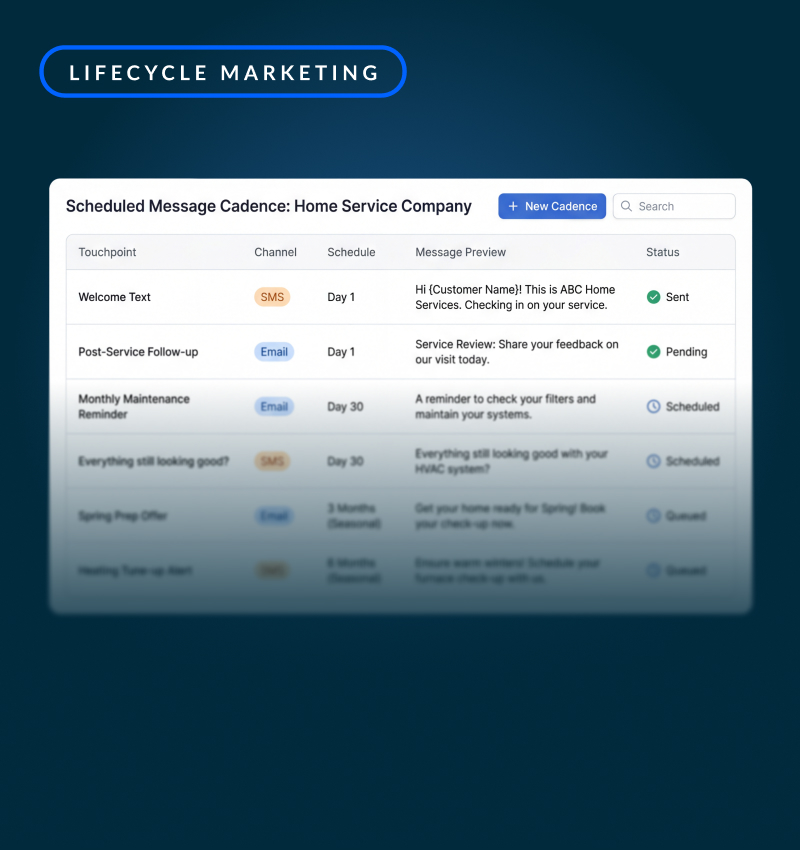
- Job completed → automatic SMS review request
- Follow-up email if no response
- Ongoing monitoring of new reviews
- Responses handled within 1–2 days
That’s enough to create steady growth over time. The difference is that it runs every time, for every customer.
Create a Reputation That Works for You
Homeowners are making decisions before they ever call you. A strong reputation management system makes sure what they find works in your favor—not against you.
If you want a free look at where your current setup is losing leads, we’ll audit your Google Business Profile, review volume and velocity, and response patterns—then show you exactly where your review strategy is falling short in a quick discussion.